
recent articles

what's next after hff: touring advice
13 days ago
shows from hollywood going to edinburgh fringe
3 months ago
hff26 award recipients and nominees!
4 months ago

the 2026 hollywood fringe scholarship recipients
6 months ago
award-winning shows from hollywood present at edinb...
about 1 year ago
hff25 award winners and nominees!
over 1 year ago
2025 hollywood fringe artist fund announcement!
over 1 year ago
announcing the 2025 hollywood fringe scholarship re...
over 1 year ago
meet the staff: jeannette srinivasan
over 1 year ago
hollywood fringe loudly recommits to diversity, equ...
over 1 year ago
15
JUN 2017
Thank you to everyone who participated in the Fringe Runway event at Fringe Central on June 14th. Twenty-five different #hff17 productions showed off costumes (and walked with style, grace and glitter) for our three celebrity judges. Congratulations to the winners!
First Place: Do You: Migration of the Monarchs
Second Place: Comic-Con The Musical
Third Place: Nosferatu, A Symphony in Terror.
Honorable Mention: The Rising

7
JUN 2017
You may notice a few new freaks running around the Hollywood Fringe this year. No, I’m not talking about the countless thespians and their patrons that descend on Santa Monica Blvd. every June — I’m talking about the Fringe Freaks — the official mascots of the Hollywood Fringe Festival!
Allow me to introduce myself — I’m Steve Troop, one of the creators and creature builder of the award-winning Fringe Show, “Alien vs. Musical.” That must be how the Fringe staff first became aware of my work… or maybe because I’ve been begging Fringe staff to rebuild the Freak costumes for the last several years!
Earlier this year, we finally struck a deal for me to rebuild five of the six heads for the 2017 festival. One of the things that Ben Hill wanted for the new Freaks was for me to do my own “spin” on the characters. Also, they should be light, durable and cheap.
Before I was a puppet builder, I was a cartoonist, so I decided that I wanted to make all of the characters a lot more cartoony. I did a series of sketches of the Freaks making weird faces. As luck would have it, the Hollywood Fringe was also running their contest for the Guide Cover, so I was able to further refine the characters while working on my submission. In a perfect world, I would have had my cover on the Guide, my Freaks running around and a show in production this year. Something to look forward to in 2018, I guess!

Anyway, after I figured out what the new heads were going to look like (and ran out of time), I started roughing out the shapes using the cheapest foam I could find. I use flat 1/2” thick foam clued together with contact cement to the majority of my builds. I start with cheap upholstery foam ($8-10 a sheet) until I have something resembling what I’m going for, and then take the whole thing apart to make patterns so I can rebuild it using the more expensive L200 foam ($35-55 a sheet). The more expensive stuff is more durable, holds its shape better and is — most importantly — lighter than the cheap stuff.
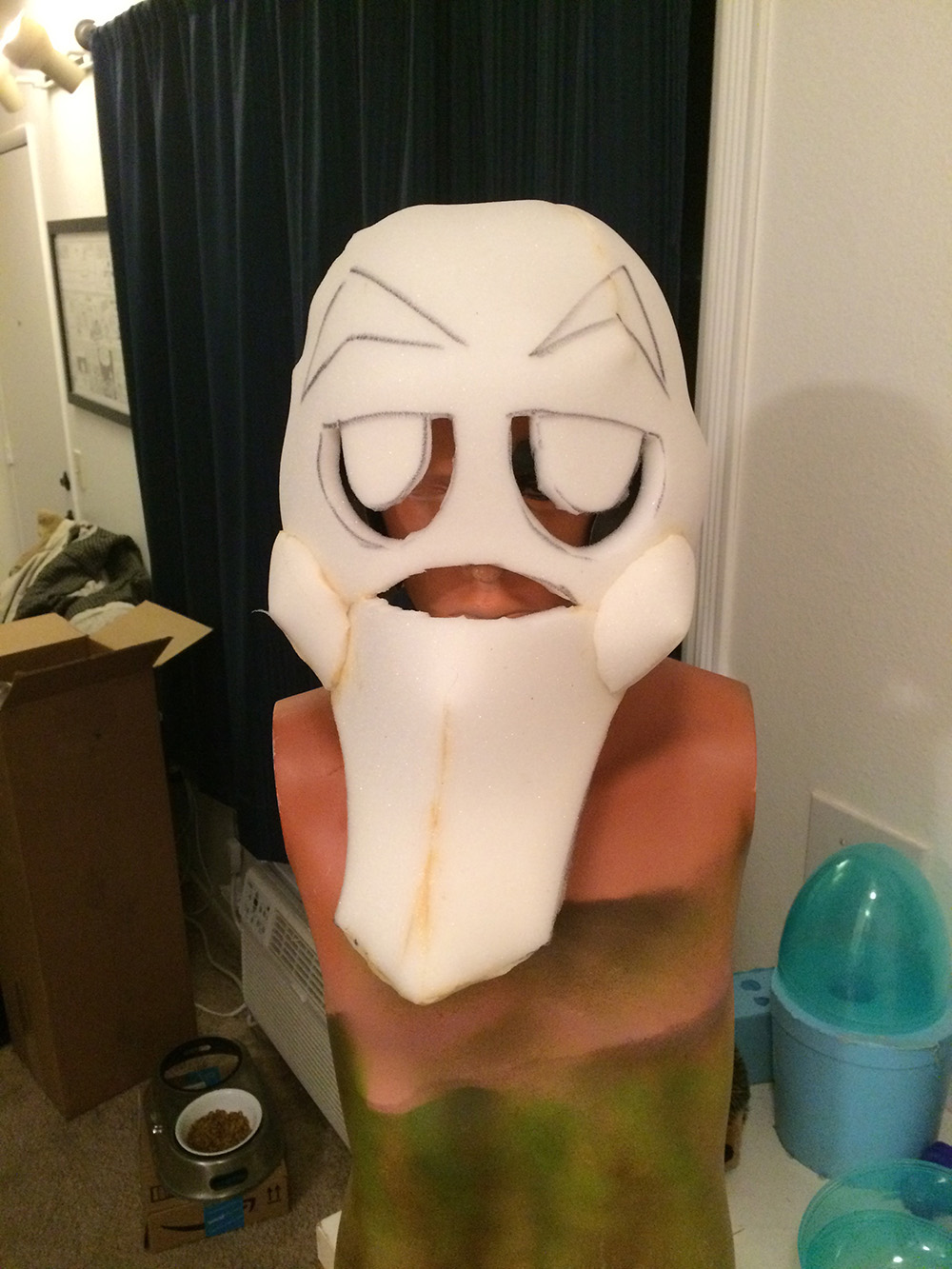
I usually try to make heads more-or-less symmetrical. During the pattern-making process, it’s possible to “true up” the patterns by tracing each half of the pattern on butcher paper, then averaging out the two sides. Then, you transfer the paper patterns to the expensive foam and glue everything together. Unfortunately, I didn’t take any pictures of this process for the Fringe heads, but my Instagram feed is full of pictures of the process on other projects.
After I had the final head built on top of a baseball helmet, I repeated the process with the “Skin” by covering it with cheap fabric, marking all the seams with a Sharpie, and then transferring it to butcher paper, truing it up and then tracing that shape onto the expensive fabric. While I was building the Freaks, my puppet shop was closing so I got a ton of free “Muppet” fleece (also called Antron Fleece). This was a considerable upgrade that should give the new heads a lot longer lifespan. Everybody wins! (except me, who now has to work out of my kitchen).
The only drawback to using Antron Fleece is that it only comes in white, so I had to dye all six colors from scratch. I did my best to match the colors, despite being color blind. Did I mention that I’m color blind? Let me tell you, it’s done wonders for both my cartooning and puppet building careers.
The last part of the process is sewing everything together. At first, I started by machine sewing what I could, but it’s much easier to hide the seams if you hand sew Antron Fleece — so aside from a few seams here and there, just about all of the heads ended up hand-sewn.
I had originally estimated 10 hours for all of the heads together, but by the time I finished, the entire process took approximately 102 hours: 26 hours for Green, 24 hours for Orange, 4 hours for Blue, 21 hours for Red, 18 hours for Purple and 9 hours for Brown. Also, I spent about 8 hours dying all the fabric. Whew!
And that, ladies and gentlemen, is why I’m not a millionaire. But — like all things Fringe, these new Freaks are a labor of love — and hopefully will entertain theatre-goes for years to come! I can’t wait to see them running around the Festival and showing up in everyone’s Instagram Accounts!
Steve’s puppet work can be seen at Puppet Design Studio.
Steve’s cartooning work can be seen at Melonpool.
Follow Steve’s latest puppet builds on instagram @melonpool

30
MAY 2017
Hi folks, my name is Corwin; you’ll usually see me fixing some technical thing somewhere, or telling longwinded stories that go nowhere. I wandered into the first Hollywood Fringe Festival with Theatre Unleashed, the first company I worked with in Los Angeles. I was doing sound design for “Friends Like These,” a piece which has since gone on all over the place.
So, if this is your first time, find me at Fringe Central and let me know how it’s going for you. At this point, you’re probably a little stressed, not quite sure how it’s all going to come together. Literally everyone else has passed through this phase as well, and everyone who’s participated more than once signed right back up for that feeling again.
Will it work? Will we get the props finished in time? Is this song too corny? Should we have added more light cues? Do I still have time to squeeze in rewrites?
It goes further than that. I’ve had acquaintances turn into friendships, metamorphosize into long-term artistic collaborations. I’ve had about a hundred jobs float effortlessly into my hands because of the chance meetings I’ve had, wandering around Hollywood in June. I’ve been lucky enough to be offered projects that proved to be some of the best work I’ve ever done, just by showing up, being friendly, and sharing a table with a perfect stranger.
But that’s not even the best thing. The best thing, the thing that keeps me coming back every year in whatever capacity they’ll allow me, the biggest and most poorly kept secret is this: There’s absolutely no telling what treasures this year may bring. There’s no way of anticipating what you might see, who may see you, what breakout successes and spectacular failures may befall any of us. Those of us that return would love to tell you our stories from the past, but the reason we keep coming back is the future.
Which is about to become one hell of a fantastic now.
I’m excited to see what you’ve brought to our potluck. It doesn’t matter if you’re a great chef or just toying with your ramen recipe. You made it, you brought enough to share, and we’ll all dine at this buffet until we’re just shy of bursting.
I do hope you come back for seconds.

25
MAY 2017
Hello! My name is Kelley and I’m a master electrician. More specifically, the master electrician for Fringe Central. Originally from Florida (no, not Disney World. North Florida), I’ve spent the better half of my life traveling around the US doing lighting for theatre, opera, dance, television, concerts, and events.
Two months after I moved to LA, I was hired to be the Fringe Central ME for HFF15 and nothing blew up, so they keep hiring me. Most of my work is done before Fringe officially opens but during the festival I can be found at Fringe Central making sure everything turns on, assisting with Cabaret, and telling people no, they can’t plug in all their various devices. I’m thrilled to be working on my third season of Fringe and can’t wait for another awesome summer of theatre.
That’s pretty much it. I’m a stagehand, I hate talking about myself.

23
MAY 2017
I carried a lot of ice that night.
The following June I was asked once again by my good friend, Bryan, to carry ice for the inaugural Hollywood Fringe Festival in 2010. So I did. I carried ice.
The next year, I helped build and dedicate the bar to remember and honor our good friend, Bryan. And I carried a lot of ice.
In 2013 my dear friend, Stacy Jones Hill, became my boss as we tackled FringeTV together. It was a year of carrying a lot of equipment, long segments, laughter, sweat, and learning. We brought those learned lessons to the table in the following year and spit out a lot of footage on FringeTV, thanks also to the help of one of my bosses this year, Nathaniel Beaver.
I’ve worn many hats for the Hollywood Fringe Festival. Bartender, Bar Manager, Food and Beverage Director, Front of House Director, FringeTV Host, FringeTV Producer, but most importantly, I carry Ice. I’ve carried ice every year. Also kegs or cases. I’ve carried them. Sold them. Probably to you, reader.